
TLDR: This article explains the common causes of Massey Ferguson overheating under load, including blocked radiators, low coolant, faulty thermostats, worn water pumps, loose fan belts and damaged hoses. It also highlights warning signs of serious engine faults and provides a practical checklist for diagnosing tractor overheating safely and effectively.
If your Massey Ferguson tractor runs normally at idle or during light work but the temperature gauge climbs when ploughing, mowing, baling or pulling a heavy load, the cooling system needs attention. Massey Ferguson overheating under load can have a relatively simple cause, such as a blocked radiator, but it can also point to a failing thermostat, water pump, fan belt or, in more serious cases, an internal engine problem.
A tractor produces considerably more heat when the engine is working hard. The cooling system must remove that additional heat quickly enough to keep the engine at its correct operating temperature. According to Perkins’ guidance on engine cooling systems, a liquid-cooled diesel engine relies on components including the radiator, thermostat and water pump to manage engine temperature effectively.
If any part of that system loses efficiency, tractor overheating under load may be the first noticeable symptom.
Why Does a Tractor Overheat Only Under Load?
A tractor running hot only during demanding work often indicates that the cooling system still has enough capacity for light operation but cannot dissipate the additional heat produced at higher engine loads.
For example, a radiator that is partly obstructed by dust, chaff or grass may appear perfectly adequate while the tractor is idling. Once the engine is operating near full power, however, airflow through the radiator may no longer be sufficient.
That is why overheating problems should be investigated before continuing heavy work. Persistent excessive temperature can eventually lead to much more expensive engine damage.
-
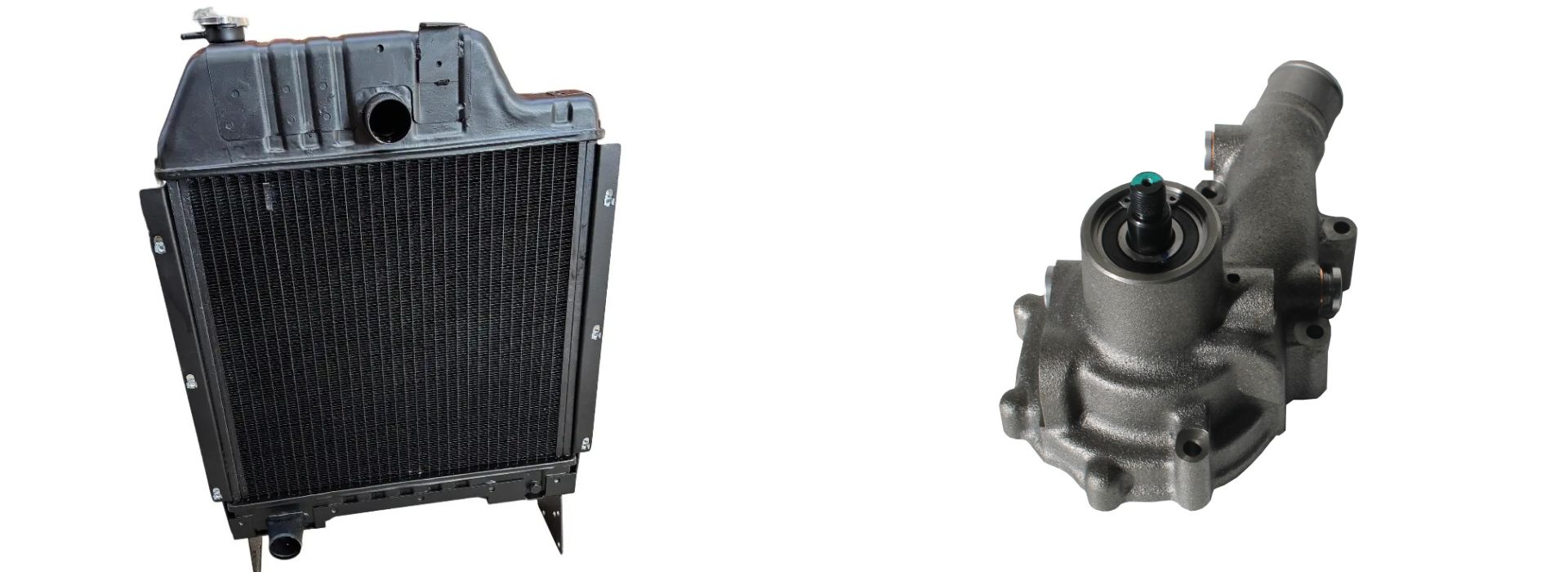
Check the Massey Ferguson Radiator
The Massey Ferguson radiator is one of the first areas to inspect when diagnosing overheating.
Agricultural tractors operate in extremely dusty environments. Seeds, grass, chaff, soil and fine dust can accumulate between radiator fins and other cooling elements. Over time, this material can severely restrict airflow.
Massey Ferguson’s tractor maintenance guidance recommends keeping radiators, condensers and coolers free from dirt and crop debris as part of regular machine maintenance.
Inspect the radiator carefully with the engine switched off and fully cooled. On tractors with several cooling packs positioned together, look between the individual cores rather than checking only the visible front surface.
Use compressed air or another cleaning method recommended in the tractor’s operator manual. Take care not to damage delicate radiator fins with excessive pressure.
A radiator can also become restricted internally by corrosion, scale or deposits. Perkins’ technical guidance on coolant explains the importance of correct coolant in protecting an engine’s cooling system against corrosion and deposits.
-
Check the Coolant Level
Low coolant is another common cause of tractor overheating.
Always check the coolant level when the engine is cold. Never remove a radiator or expansion-tank cap while the cooling system is hot and pressurised.
If the coolant is low, do not simply keep topping it up without investigating where it is going. Check the:
- Radiator and coolant hoses
- Hose clips and connections
- Radiator seams
- Expansion tank
- Thermostat housing
- Water pump
- Drain plugs
- Cylinder-head area
A small coolant leak may evaporate against a hot engine before producing an obvious puddle.
Always use coolant that meets the specification recommended for your particular tractor and engine. Coolant does more than prevent freezing; it also helps control corrosion, cavitation and deposits within the cooling system. More information on the role of coolant is available from Perkins’ engine coolant guidance.
-
Could the Thermostat Be Sticking?
The thermostat controls coolant flow according to engine temperature.
When the engine is cold, coolant flow through the radiator is restricted so that the engine reaches its normal operating temperature efficiently. As engine temperature increases, the thermostat opens and allows greater circulation through the radiator.
Perkins’ information on engine thermostats explains how the thermostat plays an important role in regulating coolant temperature and maintaining correct engine operating conditions.
A thermostat that sticks closed or fails to open fully can therefore produce classic tractor overheating under load symptoms.
The engine may behave normally during light use before gradually becoming hotter as the workload increases. Eventually, coolant circulation through the radiator becomes insufficient to control the extra heat.
Thermostats should be tested or replaced with the correct specification component rather than simply removed. The cooling system is designed to operate with the correct thermostat installed.
-
Check the Massey Ferguson Water Pump
A failing Massey Ferguson water pump can also cause an engine to overheat.
The water pump circulates coolant through the engine block, cylinder head and radiator. Perkins’ technical information on water pumps describes the pump’s role in maintaining coolant circulation so that heat can be carried away from the engine.
Water-pump problems can include:
- Worn bearings
- Dam
- aged or corroded impeller blades
- Seal failure
- Internal corrosion
- Excessive pulley movement
Warning signs may include coolant leaking around the pump, bearing noise, movement in the pulley or repeated overheating.
Importantly, a pump can sometimes appear satisfactory externally while the internal impeller is badly worn or damaged. If the radiator, thermostat and coolant level all check out, water-pump performance may need further investigation.
-
Inspect the Fan and Drive Belt
Coolant circulation is only part of the cooling process. Adequate airflow through the radiator is equally important.
Many tractor engines use a belt-driven fan, with the same drive system often operating the water pump. If the belt is loose, glazed, cracked or badly worn, both fan speed and water-pump performance can be affected.
Routine engine maintenance should therefore include checking belt condition and tension.
Check the belt according to the manufacturer’s specification. Depending on the Massey Ferguson model, you should also inspect the fan blades, tensioner, pulleys and any fan coupling fitted.
A fan that is damaged, loose or operating too slowly may allow the tractor to remain cool during light work while causing the temperature to rise quickly under load.
-
Check the Radiator Cap and Hoses
The radiator or expansion-tank cap is another component that is easy to overlook.
Cooling systems are designed to operate under controlled pressure. A damaged cap or failed pressure seal may reduce the system’s ability to control coolant temperature.
Hoses should also be inspected closely.
An ageing hose can sometimes deteriorate internally and partially collapse when engine speed increases. That can restrict coolant circulation even though the outside of the hose still looks acceptable.
Soft, swollen, cracked or oil-contaminated hoses should be investigated and replaced where necessary.
-
When Massey Ferguson Overheating Indicates a More Serious Fault
If the radiator is clean, coolant level is correct, the thermostat works, the belt and fan are functioning correctly and the water pump is circulating coolant properly, the problem may require deeper investigation.
More serious possibilities can include:
- Failed cylinder-head gasket
- Cracked cylinder head
- Combustion gases entering the cooling system
- Incorrect injection timing
- Restricted exhaust system
- Internal engine damage
Warning signs of a head-gasket or cylinder-head problem may include persistent bubbles in the coolant, unexplained coolant loss, excessive cooling-system pressure, white exhaust smoke, coolant contamination or rapid overheating soon after the tractor begins working.
These faults require proper diagnosis rather than replacing cooling-system parts one after another.
Massey Ferguson Overheating Checklist
When diagnosing a Massey Ferguson tractor that overheats during heavy work, start with the simplest and most common causes:
- Stop working if the temperature becomes excessive.
- Allow the engine to cool completely.
- Check the coolant level.
- Inspect and clean the radiator and cooling pack.
- Check the fan and drive belt.
- Look for coolant leaks and damaged hoses.
- Test the thermostat.
- Check the water pump and coolant circulation.
- Inspect the radiator or expansion-tank cap.
- If the problem remains, investigate the engine for combustion-gas leakage or other internal faults.
Following a logical diagnostic sequence can prevent unnecessary parts replacement and may identify a simple cooling problem before it causes major engine damage.
Massey Ferguson also highlights the importance of regular servicing and machine-condition checks through its official Parts & Services support, making preventative maintenance an important part of avoiding overheating problems.
Need Massey Ferguson Cooling-System Parts?
Whether the problem turns out to be a blocked Massey Ferguson radiator, faulty thermostat, damaged coolant hose, worn belt or failing Massey Ferguson water pump, it is important to identify the correct component for the specific tractor model and engine before ordering replacement parts.
If your Massey Ferguson overheating problem continues after carrying out the basic checks, professional diagnosis is advisable. Continuing to operate a tractor running hot during heavy work risks turning a straightforward cooling-system repair into expensive engine damage.
For additional servicing information, owners can consult Massey Ferguson Parts & Services, while Perkins’ cooling-system technical resources provide further useful background on diesel-engine cooling components and maintenance.
Require replacement parts for your Massey Ferguson Tractor coolant system? Browse and Buy from our Online Shop.
Would like to speak with a member of our Sales team? Feel free to reach out on our Contact page.