
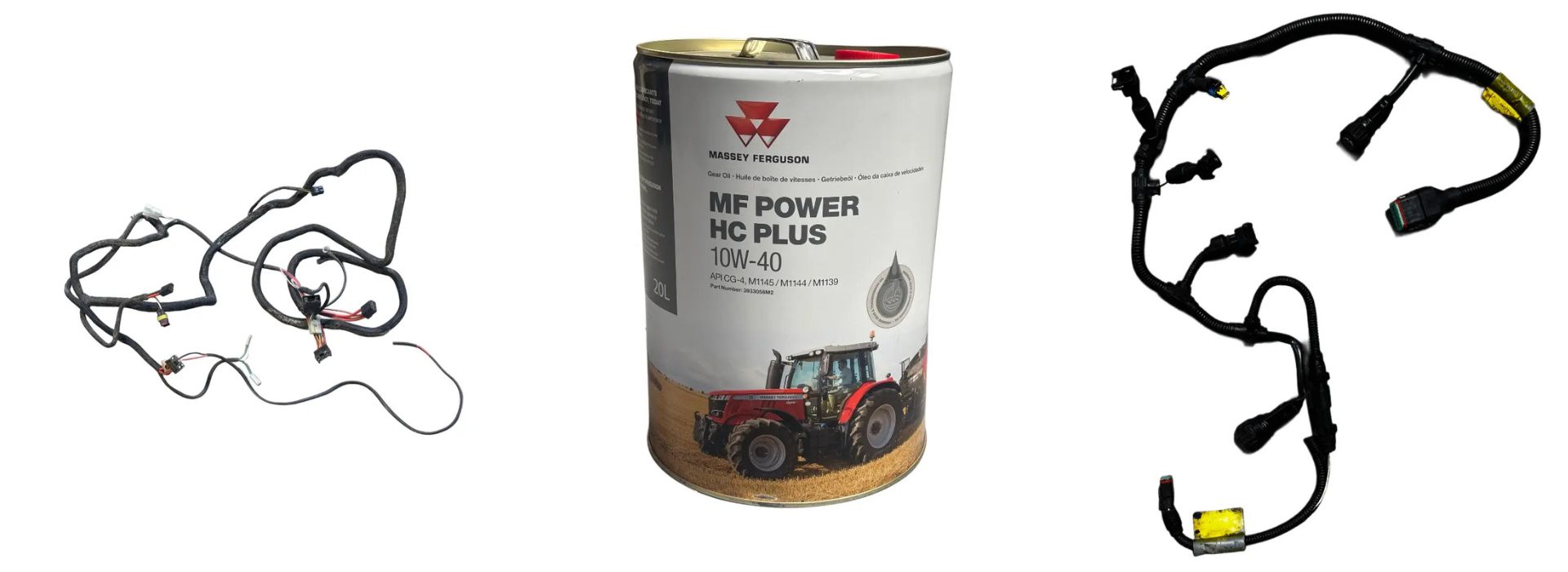
TLDR: If your Massey Ferguson 4WD won’t engage or disengage, the fault could be electrical, hydraulic or mechanical. Common causes include faulty switches, damaged wiring, failed solenoids, sensor problems, low hydraulic pressure, worn clutch components and damaged driveline parts. A step-by-step diagnosis can prevent unnecessary and expensive repairs.
If your Massey Ferguson 4WD won’t engage or refuses to disengage, the fault can usually be traced to one of three areas: the electrical controls, the hydraulic control system or the mechanical drivetrain.
On many Massey Ferguson tractors, four-wheel drive is controlled electronically through a dashboard switch, wiring loom, relay, sensors and a solenoid-operated hydraulic valve. On older or simpler models, the system may rely more heavily on mechanical linkage and drivetrain components.
That means a 4WD fault does not automatically point to a failed front axle. In many cases, the problem is something much simpler, such as a faulty switch, damaged wiring, corroded connection or failed solenoid.
A logical diagnostic process can help avoid replacing expensive components unnecessarily.
Start With the 4WD Switch
The first place to check is the Massey Ferguson 4WD switch.
On electronically controlled tractors, the switch usually sends a signal to the tractor’s control system rather than directly engaging the front axle. A worn or damaged switch can therefore cause several symptoms, including:
- 4WD failing to engage.
- 4WD failing to disengage.
- Intermittent operation.
- A dashboard indicator that does not respond correctly.
- A system that only works when the switch is pressed several times.
Check whether the 4WD warning light changes when the switch is operated, but remember that an illuminated symbol does not always prove the front axle has actually engaged.
Because the electrical logic varies between Massey Ferguson models, it is worth checking the correct operator or service information before testing individual components.
Massey Ferguson provides model-specific operator manuals and diagnostic support through its official Service & Information portal:
Massey Ferguson Service & Information
Check Fuses, Relays and Electrical Supply
Before replacing a 4WD solenoid, check the simple electrical components first.
Inspect:
- Fuses
- Relays
- Battery connections.
- Earth points.
- Wiring connectors.
- Fuse holders.
- Wiring around the transmission and cab.
A partially corroded connector may still show voltage when tested with no load, but may not allow enough current to operate a solenoid correctly.
Electrical test equipment manufacturer Fluke recommends voltage-drop testing for identifying excessive resistance in wiring, connectors and ground circuits.
Their automotive electrical troubleshooting guidance is useful for understanding how poor connections can cause intermittent electrical faults:
Fluke Electrical Troubleshooting Guide
This type of testing can be particularly useful on tractors, where wiring is regularly exposed to mud, moisture, fertiliser, vibration and pressure washing.
Inspect the Wiring Harness
Damaged wiring is one of the most common causes of intermittent electrical faults on agricultural machinery.
Follow the wiring associated with the 4WD system and pay particular attention where it:
- Runs underneath the cab.
- Passes close to the gearbox or transmission.
- Crosses brackets or sharp edges.
- Runs near exhaust components.
- Enters solenoid plugs.
- Has previously been repaired.
Unplug accessible connectors and inspect them for green corrosion, damaged pins, loose terminals or moisture.
Do not overlook earth connections either. A poor ground can prevent a perfectly good solenoid or relay from operating correctly.
Test the 4WD Solenoid
Many Massey Ferguson tractors use an electro-hydraulic solenoid to control four-wheel drive.
The solenoid receives an electrical command and operates a hydraulic valve controlling the 4WD clutch or engagement mechanism.
A technician will normally check:
- Whether voltage reaches the solenoid.
- Whether the voltage changes when the 4WD switch is operated.
- Solenoid coil resistance.
- Ground integrity.
- Connector condition.
- Whether the solenoid physically actuates.
If power and ground are correct but the solenoid does not respond, the solenoid itself may need replacing.
It is important to check the operating principle for the exact model. On some tractor systems, the solenoid may be used to disengage 4WD rather than engage it. This means an electrical failure could leave four-wheel drive permanently engaged.
AGCO provides official workshop manuals and technical publications for Massey Ferguson equipment through its technical publications system.
Using the correct wiring diagram is particularly important before testing control terminals or replacing a solenoid.
Brake Switches and Speed Sensors
On more modern Massey Ferguson tractors, the four-wheel-drive system can interact with other tractor functions.
Depending on the model, the control system may use signals from:
- Brake pedal switches.
- Transmission speed sensors.
- Wheel speed sensors.
- Electronic control units.
- Other drivetrain sensors.
Some tractors automatically engage 4WD during braking to improve braking performance through all four wheels.
A faulty brake switch or sensor can therefore create symptoms that appear to be a problem with the 4WD system itself.
If the tractor supports electronic diagnostics, check stored fault codes before replacing components.
Massey Ferguson’s official support portal includes access to diagnostic information for supported machines:
Massey Ferguson Service & Diagnostic Information
Check Hydraulic Oil and Pressure
If the electrical side is functioning correctly, the next area to investigate is the hydraulic control system.
An electrically operated solenoid may be working correctly, but four-wheel drive may still fail if the hydraulic pressure required to operate the clutch is too low.
Possible causes include:
- Low transmission oil level.
- Incorrect oil specification.
- Dirty or restricted transmission filter.
- Sticking hydraulic valve.
- Low control pressure.
- Internal hydraulic leakage.
- Failed piston seals.
If the tractor is also experiencing powershift problems, transmission warning lights or other hydraulic symptoms, this may suggest a wider pressure problem.
Always use the transmission and hydraulic oil specified for the exact Massey Ferguson model.
Mechanical 4WD Problems
If the switch, wiring, solenoid and hydraulic controls all test correctly, the fault may be mechanical.
Common areas to inspect include:
- 4WD clutch packs.
- Splined shafts.
- Driveshaft couplings.
- Universal joints.
- Transfer gears.
- Front differential.
- Front axle half shafts.
- Hub and final-drive components.
A stripped spline can create a particularly confusing symptom.
The 4WD clutch may engage correctly and the control system may behave normally, but power will not reach the front wheels.
Check the front driveshaft and universal joints for excessive movement, knocking, vibration or damaged splines.
If there are grinding or clicking noises from the front axle, further inspection of the differential, bearings and final-drive components may be required.
What If the 4WD Won’t Disengage?
A Massey Ferguson 4WD that won’t disengage is just as important to diagnose.
One possibility is drivetrain wind-up.
When four-wheel drive is used on a hard, high-grip surface, slight differences in tyre circumference and axle gearing can cause tension to build between the front and rear drivetrains.
This can make the system temporarily difficult to disengage.
Try moving the tractor slowly onto loose ground and travelling forwards or backwards before trying the switch again.
If 4WD remains engaged, check:
- 4WD switch.
- Solenoid operation.
- Wiring and relay.
- Brake switches and sensors.
- Hydraulic valve.
- 4WD clutch.
- Mechanical engagement components.
Avoid prolonged driving on dry roads with 4WD permanently engaged because this can increase tyre wear and place additional stress on shafts, gears and axle components.
Suggested Replacement Parts
Depending on the fault found, commonly required replacement parts may include:
- 4WD switch – if the dashboard control is worn or intermittent.
- 4WD solenoid – if electrical supply is correct but the solenoid does not operate.
- Relay or fuse – if the electrical control circuit has failed.
- Wiring connectors or terminals – where corrosion or poor contact is present.
- Wiring harness section – where the loom is badly damaged.
- Brake pedal switch – where 4WD operation is linked to braking.
- Transmission or speed sensor – where incorrect electronic signals are affecting operation.
- Transmission or hydraulic filter – if restricted oil flow is suspected.
- Transmission/hydraulic oil – if the level or specification is incorrect.
- 4WD clutch plates and discs – if the clutch is worn or slipping.
- Clutch piston seals and O-rings – where internal hydraulic leakage is present.
- Front driveshaft or universal joints – where excessive wear or vibration is found.
- Splined couplings – if power is not being transferred correctly.
- Front axle bearings, shafts or differential components – where the fault is mechanical.
Always identify replacement parts using the tractor’s full Massey Ferguson model and serial number, as components can vary significantly between transmissions, axle types and production years.
A Sensible Massey Ferguson 4WD Diagnostic Order
A practical troubleshooting sequence is:
- Confirm whether 4WD is failing to engage, disengage or both.
- Check the dashboard switch and indicator.
- Check fuses and relays.
- Inspect wiring and earth connections.
- Test the 4WD solenoid.
- Check brake switches and relevant sensors.
- Read diagnostic fault codes where available.
- Check transmission oil level and condition.
- Test hydraulic control pressure if required.
- Inspect the 4WD clutch, driveshaft, splines and front axle.
Following this order helps rule out simple electrical problems before moving on to more expensive hydraulic or mechanical repairs.
Final Thoughts
When a Massey Ferguson 4WD won’t engage or disengage, do not immediately assume the front axle or transmission needs major repair. Faulty switches, damaged wiring, corroded connectors, relays, sensors and 4WD solenoids are all worth checking first. If the electrical controls are working correctly, move on to hydraulic pressure, clutch operation and finally the mechanical drivetrain. For the most accurate diagnosis, always use service information for the exact tractor model and serial number. Massey Ferguson and AGCO provide official manuals and technical publications that can help identify the correct wiring, hydraulic and drivetrain layouts.
Need replacement parts for your Massey Ferguson tractor? Browse and Buy from our Online Shop.
Would like some advice on buying parts for your tractor. Feel free to direct your queries to our Contact page.