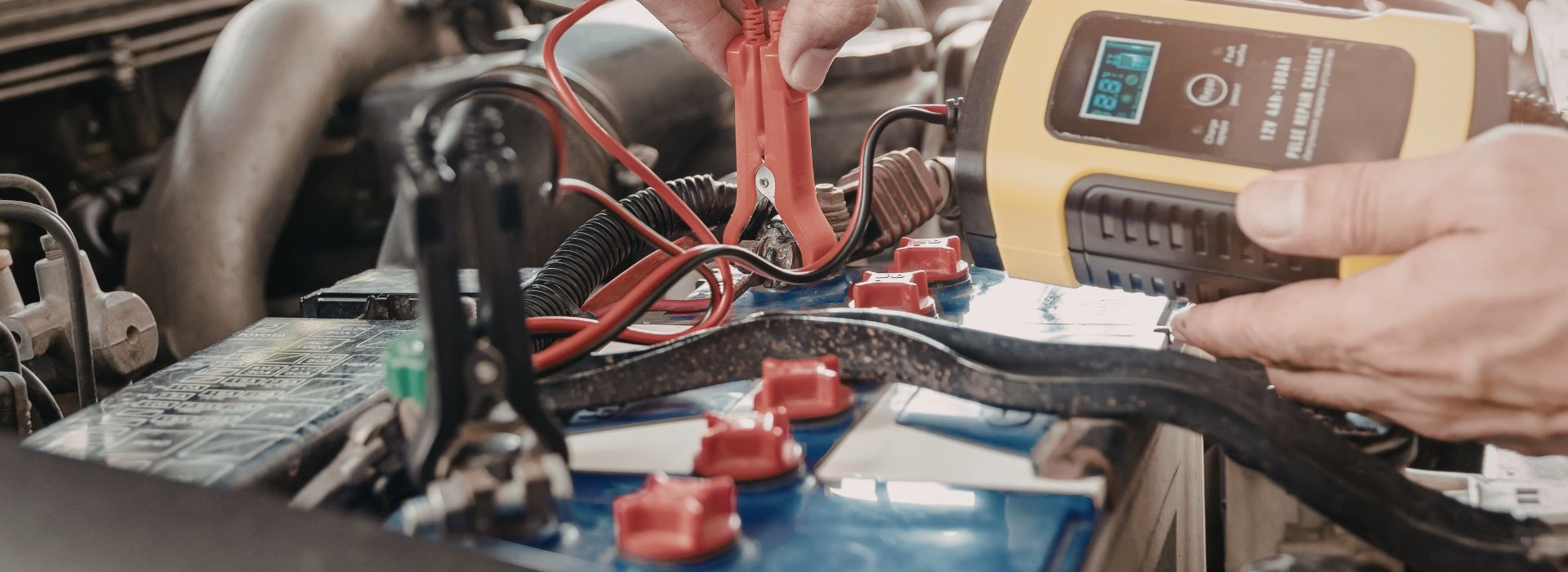
If your Massey Ferguson tractor won’t start—especially if it clicks or won’t crank—the problem is usually electrical, not mysterious. In most cases, the starter motor simply isn’t getting enough voltage under load or enough current because of corrosion, loose connections, weak battery capacity, or worn solenoid contacts. The quickest fix is a disciplined test order: battery – connections/earths – solenoid – starter.
Before anything else, take the safety warning seriously: do not short across starter terminals, do not bypass the safety system, and only start the tractor while seated. Check out this example of a Massey Ferguson operator manual for more information.
Tools you’ll need
- A digital multimeter
- Basic spanners, wire brush/emery cloth, contact cleaner
- A battery charger (smart charger ideal)
- Optional: jump pack or known-good battery; a battery load tester
Step 1: Identify the symptom (it tells you where to look)
When you turn the key to START, which of these happens?
- Nothing at all (no click, no dimming): battery connection, fuse/relay feed, ignition switch, or a safety interlock is likely.
- Single heavy click but no crank: the solenoid is moving, but high-current power isn’t reaching (or passing through to) the starter. Nick Young Tractor Parts have a handy blog about what to do when your track won’t crank. Read it here.
- Rapid clicking: battery voltage is collapsing under load—often a weak battery or high resistance at terminals/earths.
- Slow crank: battery weak, cables/earths resistive, or a tired starter motor drawing too much current. Voltage-drop testing is the fastest way to prove which. Find out more about voltage testing here.
This guide focuses on no-crank/clicking faults (battery, starter, solenoid, earths).
Step 2: Battery checks (don’t skip—many “starter faults” are battery faults)
2A) Check resting voltage
Measure directly across the battery posts (not the clamps), with the tractor off and the battery rested.
A fully charged 12V lead-acid battery typically reads around 12.6–12.8V at rest, as referenced from Engine School.
If you’re well below that, charge first and retest—diagnosing a half-flat battery leads to false conclusions. (Some load-test guides even stress charging first to avoid misdiagnosis.)
2B) Check cranking voltage (the truth test)
Keep the meter leads on the battery posts and crank for 5–10 seconds.
A commonly used pass/fail benchmark for load/crank performance is that voltage should not drop below about 9.6V during a proper load period. Find out more here.
- If the voltage dives hard and stays low: suspect battery capacity (or a severe connection issue).
- If the voltage stays relatively strong but it still won’t crank: move on to cables/earths and solenoid testing.
Step 3: Cables and earths (grounds) — the most common tractor culprit
Outdoor machines suffer from corrosion, vibration, and paint/grease at connection points. Even if things “look fine,” resistance can be high enough to stop a starter dead.
The best method: voltage-drop testing under load
Fluke’s troubleshooting guidance is clear: voltage-drop testing reveals resistance you can’t see, and it’s often the fastest way to pinpoint a restricted starter circuit.
3A) Earth-side (ground) voltage drop test
- Black lead on battery negative post
- Red lead on starter motor body (clean metal point)
- Crank and read the voltage
A high reading here means the starter can’t return current properly—classic earth strap / ground connection fault. Nick Young Tractor Parts’ MF-specific guide highlights earth straps and poor connections as a primary cause of “clicks but won’t crank.”
3B) Positive-side voltage drop test
- Red lead on battery positive post
- Black lead on the starter main terminal (where the heavy cable lands)
- Crank and read
A high reading here points to resistance in the positive cable path, isolator switch (if fitted), terminals, or solenoid contacts.
Fix the connection faults properly (so it doesn’t come back)
- Remove and clean battery posts and clamps to bright metal
- Inspect heavy cables for stiffness, swelling, green corrosion under insulation, loose or heat-damaged lugs
- Remove and clean the engine-to-chassis earth strap ends; refit tight to clean metal
- Ensure ground points aren’t painted or oily—starters need solid metal-to-metal contact
Step 4: Solenoid checks (control signal vs high-current switching)
The solenoid does two jobs: it pulls in (you hear a click) and it connects battery power to the starter through high-current contacts. You can have a loud click and still have no crank if those contacts are worn.
4A) Check the “start signal” (small terminal)
With the meter referenced to ground, probe the solenoid’s small trigger terminal while turning the key to START. If the signal is missing or weak, suspect ignition feed, start relay, wiring, or interlocks—real-world tractor diagnostics often trace intermittent clicking to resistance in the start command circuit, as referenced in this tractor forum.
4B) Check solenoid input vs output (big studs)
If there’s a solid click but no crank:
- Measure voltage at the battery feed stud (solenoid input) while cranking
- Measure voltage at the starter feed stud (solenoid output) while cranking
If input is good but output is poor, the solenoid’s internal copper contacts can be burnt/pitted—an MF-click/no-crank pattern called out in MF-focused troubleshooting.
Step 5: Starter motor checks (only after battery, cables, and solenoid test good)
If:
- Battery passes cranking/load expectations (or is confirmed good),
- Voltage-drop tests show low resistance on positive and earth paths,
- Solenoid output is delivering proper voltage,
…but it still won’t crank or cranks very slowly, the starter motor is now the prime suspect. Many “don’t buy a starter yet” guides still note that once power delivery is proven, internal starter faults (brushes, commutator, seized motor) become likely.
Parts most often replaced with these issues (what customers actually end up needing)
Once your tests identify where the loss is, these are the common replacement parts for “won’t start / click / no-crank” faults:
1) Battery and battery terminals
- Battery (fails load/cranking performance or won’t hold charge)
- Battery terminals/clamps (won’t tighten, cracked, heavily corroded causing voltage drop—often the cheapest “major fix”)
2) Earth/ground parts (very common on tractors)
- Engine-to-chassis earth strap (corroded/frayed/high resistance under load)
- Negative battery cable (internal corrosion or broken strands at lugs)
3) Heavy positive cables and isolator (if fitted)
- Battery-to-solenoid cable and solenoid-to-starter cable (corroded lugs, heat damage, high drop under cranking)
- Battery isolator/master switch (worn contacts causing resistance—acts like a weak battery)
4) Solenoid and start relay
- Starter solenoid (clicks but doesn’t pass current due to burnt contacts)
- Starter relay (if used; can click but not deliver solid current to the solenoid trigger circuit)
5) Starter motor assembly
- Starter motor (internal wear/seizure; replace or rebuild once you’ve proven supply and earth are good)
Practical replacement order (most common in the field): terminals/earth strap – heavy cables – solenoid – starter motor (last).
Quick troubleshooting summary
- Charge and test the battery properly (resting ~12.6–12.8V; cranking/load shouldn’t collapse below common thresholds).
- Use voltage-drop testing while cranking to find hidden resistance in earths and cables.
- A click doesn’t guarantee the solenoid is passing current—test input vs output under load.
- Only blame the starter motor after the circuit proves healthy.
- Follow operator-manual safety warnings—no bypassing.
Having trouble starting your Massey Ferguson Tractor? Get in touch with a member of our team on our Contact Us page.
Require replacement parts? Browse & Buy now from our Online Shop.