
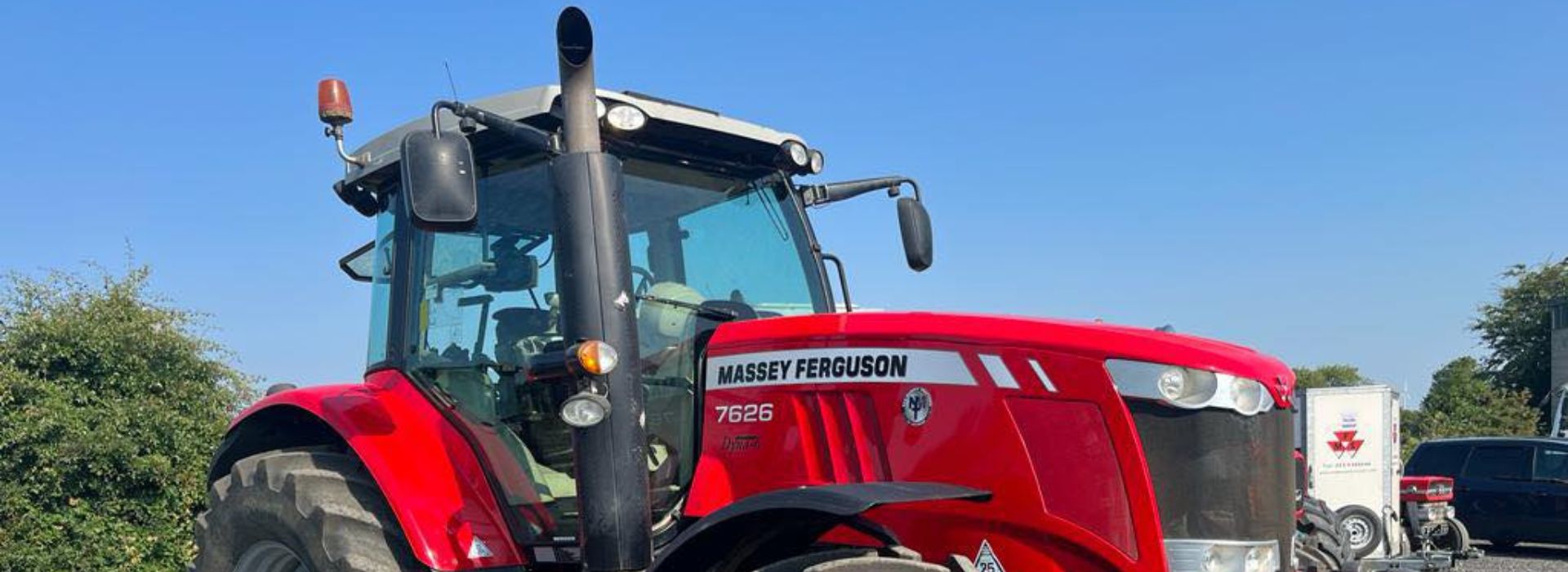
TLDR: Massey Ferguson road-speed clunks and vibration are often caused by worn propshaft universal joints, centre support bearings, rubber mounts, or driveline misalignment. This guide explains the symptoms, inspection points, and the parts most commonly replaced, helping tractor owners diagnose vibration issues early and prevent more serious driveline damage.
If your Massey Ferguson tractor develops a clunk when taking up drive, a vibration through the floor at transport speed, or a harsh shudder on acceleration, the problem is often in the driveline rather than the tyres. On road runs, even minor wear in the propshaft system becomes much more noticeable because driveshaft speed increases and any looseness, imbalance, or misalignment is amplified. Dana’s Spicer technical guidance notes that universal-joint operating angles are directly related to driveshaft speed, and that operating angles above 3 degrees can reduce joint life and may cause vibration. Dana also explains that wear over time can alter the original driveline geometry and introduce vibration problems.
For Massey Ferguson owners, that makes a methodical inspection essential. A single clunk when moving from overrun to drive often points to excessive play somewhere in the shaft line. A vibration that builds with road speed often suggests worn universal joints, a failing support bearing, or an alignment issue. If the vibration is accompanied by a heavier thump under changing load, deteriorated mounts may also be allowing too much driveline movement. SKF states that driveshaft support bearings are designed to provide precise alignment and support, while their rubber support cushions isolate the driveshaft from damaging vibration.
Check the universal joints first
Universal joints are one of the most common causes of driveline clunks and road-speed vibration. As the bearing cups and needle rollers wear, the joint develops play. That slack is often felt as a knock or clunk when pulling away, changing load, or lifting off the throttle. If lubrication has been poor, the joint may also begin to bind or run rough, creating a vibration that becomes more obvious at transport speed. Dana’s driveline guidance specifically links excessive operating angle and geometry-related stress to reduced universal-joint life and vibration.
A practical check starts with the basics: inspect the joint cups for rust staining, missing clips, seal damage, or signs of grease loss. Then check for rotational play and roughness with the machine safely shut down and secured. Any notchiness, stiffness, or visible looseness is a red flag. Weasler describes the cross-and-bearing kit as the core of the PTO driveshaft, and its product information shows that lubrication intervals can be as short as eight hours on some applications, underlining how important proper servicing is for driveline longevity.
Check alignment and operating angles
Even if a universal joint is not badly worn, incorrect alignment can still create vibration. Dana says the maximum operating angles recommended by Spicer engineers are directly related to driveshaft speed, and warns that angles greater than 3 degrees may cause vibration and shorten joint life. Dana also notes that vehicles do not usually leave the factory with vibration caused by improper U-joint angles, but wear, suspension changes, or height changes over time can create those problems later.
That principle matters on tractors used for road transport. Worn supports, damaged brackets, sagging mounts, or previous repair work can all alter the shaft line enough to create a noticeable vibration. If a propshaft has recently been repaired, it is also worth checking phasing and installation, because even a new part can vibrate if it has been assembled incorrectly.
Inspect the centre support or carrier bearing
If your Massey Ferguson uses a two-piece shaft, the center support bearing is another common failure point. SKF says its driveshaft support bearings are engineered to deliver precise alignment and support, and that the rubber support cushions are there to isolate the driveshaft from damaging vibration. When the bearing wears or the rubber support weakens, the shaft can sag or move excessively under torque. The result may be a drone, floor vibration, or a clunk when changing from drive to overrun.
Look for cracked or perished rubber, roughness in the bearing itself, witness marks showing abnormal shaft movement, or a support bracket that has shifted or been damaged. A support bearing fault can sometimes feel like a gearbox or rear axle issue, but the vibration often seems strongest from beneath the cab or mid-tractor area.
Do not overlook engine and transmission mounts
Mounts are often ignored because they are not part of the shaft itself, but they can have a major effect on driveline behaviour. Bridgestone Industrial describes engine mounts as vibration-isolation components used extensively in construction and agricultural machinery, while its technical product information highlights that properly designed mounts combine load support with isolation performance and durability.
When mounts soften, split, or collapse, the engine or transmission can move more than intended. That movement can alter the driveline angle enough to create a vibration, and it can also cause a clear clunk as torque is applied and released. Check for crushed rubber, loose mounting hardware, oil contamination, or metal-to-metal contact.
What parts often need to be replaced?
When these symptoms appear, the parts most often replaced are the wear items that control driveline movement and alignment.
The first and most common replacement is usually the universal joint or cross-and-bearing kit. This is the part most directly associated with take-up clunks and speed-related vibration. Weasler identifies the cross-and-bearing kit as the core of the PTO driveshaft, which reflects how central it is to proper driveline operation.
The next common repair is the centre support bearing or carrier bearing assembly, especially on two-piece shaft arrangements. In many cases, this also means replacing the surrounding rubber support mount, because the rubber cushion is part of the vibration-isolation system described by SKF.
After that, engine mounts and transmission mounts are frequently replaced when the shaft itself is serviceable, but the tractor still thumps or vibrates under changing load. Because these mounts hold the powertrain in position while isolating vibration, deterioration here can create secondary driveline symptoms even when the propshaft is not the root problem as stated by Bridgestone.
Less often, but still commonly enough in higher-wear tractors, the sliding spline or slip-joint section may need repair or replacement if backlash or wear is present. And where a shaft has been run for too long with worn joints or poor support, a complete propshaft assembly may be required if the tube is bent, out of balance, or damaged at the yokes. Dana’s technical material makes clear that driveline geometry and operating-angle problems can damage multiple components when left unresolved.
A practical checklist before ordering parts
Before replacing anything, work through a sensible inspection routine. Listen for whether the noise happens on pull-away, lift-off, steady-speed transport, or only under load. Check the universal joints for play, stiffness, and grease loss. Inspect the centre support bearing and its rubber mounting. Look closely at engine and transmission mounts. Then check for shaft misalignment, incorrect phasing, or bracket damage. Finally, review lubrication history, because poor maintenance is often what starts the failure chain in the first place. Weasler’s service data and product information reinforce how important correct lubrication intervals are for cross-and-bearing life.
To finish off
A Massey Ferguson that clunks and vibrates on the road is usually suffering from uncontrolled movement somewhere in the driveline. In many cases, the repair is not especially complicated, but it does require a structured inspection of the propshaft joints, support bearings, and mounts. Start with the most common wear items: U-joints, carrier bearings, and mounting rubbers. Then move on to engine and transmission mounts, alignment, and shaft condition. Catching the problem early can prevent more expensive damage.
Would like to speak with a member of our team? Feel free to get in touch on our Contact page.
Wish to our some replacement parts for your Massey Ferguson Tractor? Browse and Buy from our Online Shop.