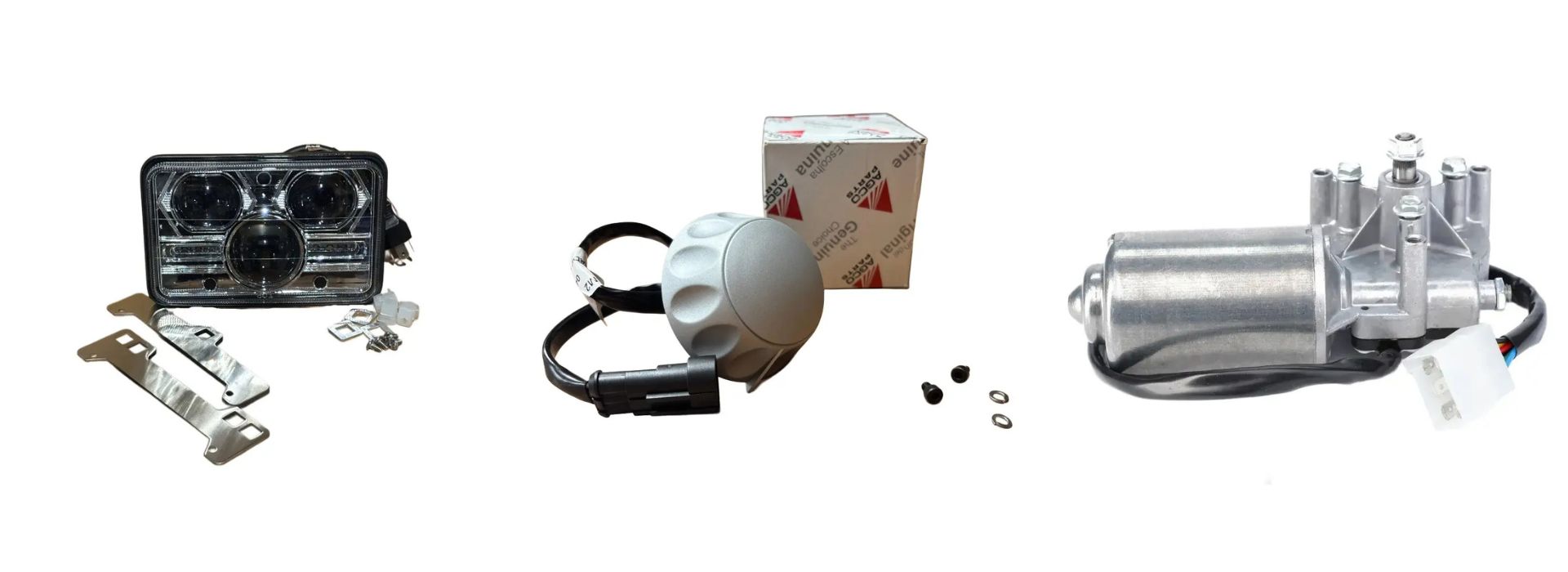
TLDR: Choose Massey Ferguson parts by repair risk: OEM for critical systems and precise fit, aftermarket for proven-value service and wear items, and used/salvage for older tractors and inspectable assemblies. Most replaced parts include filters, belts, hoses, batteries, brakes, and seals—so plan maintenance and stock accordingly.
When a Massey Ferguson goes down mid-season, the “right” replacement part isn’t always the most expensive one—and it’s not always the cheapest. The smart choice depends on what you’re repairing, how long you need the fix to last, and how much the downtime costs you.
In this guide, we’ll break down three main options—Massey Ferguson OEM parts, economy/aftermarket parts, and used/salvage parts—and match each to the repair situations where it makes the most sense. We’ll also cover the parts most commonly in need of replacement, so you can plan maintenance (and stocking) more intelligently.
The 3 part types, explained
1) OEM (Original Equipment Manufacturer)
OEM parts are built to the original spec for your machine—designed, tested, and supported through the manufacturer’s official parts network. For Massey Ferguson, that typically means Genuine AGCO Parts supplied through AGCO/MF channels. AGCO positions genuine parts as engineered and tested to meet original specifications and fit. Learn more about genuine parts from AGCO here.
This is the category people mean when they search for massey ferguson oem parts: the “buy once, fit once” approach for repairs where reliability matters.
2) Aftermarket / Economy parts
Aftermarket parts are made by third-party manufacturers. Some are excellent (especially from reputable brands with consistent QA), while others are built primarily to hit a low price.
This is the category that shows up in searches like:
- aftermarket massey ferguson tractor parts
- massey ferguson aftermarket parts
A lot of practical guidance on OEM vs aftermarket boils down to risk: aftermarket can be a strong value when the part is straightforward and quality is proven, while OEM tends to win where precision and reliability are critical. Read more about the difference between OEM and Aftermarket here.
3) Used / Salvage / Second-hand parts
Used parts (often from dismantlers/breakers) can be the most cost-effective way to keep older tractors working—especially when new pricing doesn’t stack up against the machine’s value.
You’ll see these searched as:
- massey ferguson salvage parts
- massey salvage parts
- massey ferguson second hand parts
- massey ferguson used parts
- used massey ferguson tractor parts
- used massey ferguson tractor parts for sale
Used is about value and availability—balanced against condition uncertainty.
What parts are most commonly in need of replacement?
Across tractor maintenance references, the most frequently replaced items are the predictable “consumables and wear parts”—things exposed to dirt, heat, friction, vibration, and pressure. The repeat offenders are: filters, belts, hoses (especially hydraulic), batteries, brake wear parts, and seals. Find out more here.
Here’s how that typically breaks down:
1) Filters (the #1 repeat purchase)
- Engine oil filter
- Air filter
- Fuel filter
- Hydraulic filter
These clog and load with contamination and are replaced on service intervals.
Best part type choice: OEM or reputable aftermarket. For filters, quality matters—cheap media can cost you more later.
2) Belts
Drive/fan/alternator belts crack, glaze, stretch, or fail with age and heat.
Best part type choice: Often reputable aftermarket is excellent value; OEM is a safe pick if availability is easy.
3) Hoses (coolant, fuel, and especially hydraulic)
Hoses perish, chafe, and burst; hydraulic hoses are a common “sudden downtime” failure.
Best part type choice: OEM or known-quality aftermarket; avoid bargain hoses on high-pressure circuits.
4) Batteries and terminals
Seasonal use, vibration, and charging issues make batteries a frequent replacement item.
Best part type choice: Quality aftermarket is typical; focus on correct spec and warranty.
5) Brake wear parts
Brake pads/shoes and related hardware wear with loader work, hills, road travel, and heavy use.
Best part type choice: OEM for confidence on critical components; reputable aftermarket can be fine if proven.
6) Seals, O-rings, and gaskets
Leaks are a way of life on working tractors; seals and O-rings are commonly replaced when seepage becomes a problem or during rebuilds. (This also overlaps with hydraulic hose work.)
Read more about the most commonly replaced tractor parts on this blog here.
Best part type choice: OEM or premium aftermarket—cheap seals can mean doing the job twice.
Which part type suits which repair?
Choose OEM when failure is expensive (or risky)
If the wrong part can cause a breakdown, damage other components, or create a safety risk, OEM is usually the best “uptime insurance.” AGCO specifically emphasises genuine parts as designed/tested/engineered to meet original specs.
OEM is a strong default for:
- Engine sensors and electronics
- Fuel system components where calibration/tolerances matter
- Hydraulic control components (valves, certain control parts)
- Internal engine/transmission components
- Safety-critical systems
Best-fit scenario: Your tractor is a daily workhorse and downtime is costly.
Choose aftermarket when the part is straightforward and the value is clear
Aftermarket shines when the part is:
- Non-electronic
- Easy to verify
- Not dependent on tight tolerances
- Available from a reputable manufacturer
Aftermarket often makes sense for:
- Filters and service items (from trusted brands)
- Belts and many hose applications (quality-dependent)
- Some brake wear items (brand-dependent)
- Body/cosmetic parts
General industry guidance consistently frames aftermarket as a cost/availability advantage—provided you choose a trustworthy supplier and correct spec.
Choose used/salvage when the tractor is older—or new doesn’t make economic sense
Used and salvage parts can be perfect when:
- OEM pricing doesn’t match tractor value
- New parts are discontinued/backordered
- You need assemblies/castings that are expensive new
Used/salvage often makes sense for:
- Panels, bonnets, cab parts, trim
- Castings, brackets, housings
- Non-wear assemblies you can inspect properly
This is where massey ferguson salvage parts, massey ferguson second hand parts, and used massey ferguson tractor parts for sale searches really pay off—if you buy smart.
A practical “risk ladder” for choosing the right part
When you’re deciding between massey ferguson oem parts, massey ferguson aftermarket parts, and used massey ferguson tractor parts, ask:
-
If this fails, what happens?
Big downtime or collateral damage, then lean towards OEM.
-
Is fit/calibration critical?
Electronics/controls → then lean towards OEM.
-
Can I inspect condition and verify compatibility?
If yes, then massey ferguson used parts / massey salvage parts can be great value.
How to buy used/salvage parts without getting burned
If you’re shopping used massey ferguson tractor parts:
- Match part numbers and diagrams using official parts books/catalogues
- Ask for clear photos of wear surfaces, splines, threads, connectors
- Confirm model/serial range compatibility
- Prefer dismantlers with clear returns/testing notes (especially for electronics)
- Be cautious with unknown ECUs/sensors unless tested
The bottom line: match the part to the job
- Go OEM for critical systems, electronics, controls, high-tolerance components—maximum confidence and fit.
- Go aftermarket for common wear/service items when you choose reputable quality—strong value and availability.
- Go used/salvage for older tractors, cosmetic parts, castings, and inspectable assemblies—especially when new pricing doesn’t make sense.
We at Ned Murphy Tractors sell OEM, Aftermarket (Economic) and Used (Salvaged) parts. Browse on our Online Shop to find the best options for your Massey Ferguson tractor.
Wish to speak to someone in our parts department? Feel free to get in touch on our Contact Us page.