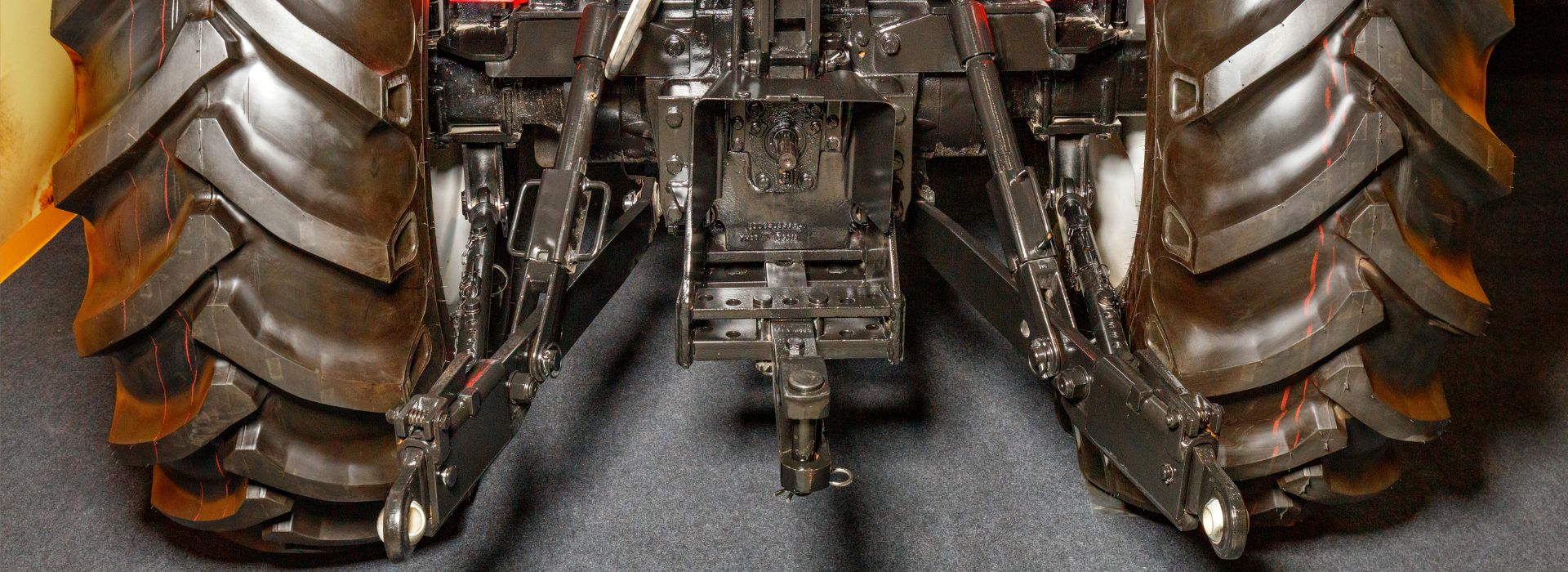
If you’ve ever searched “ferguson 3 point hitch”, “ferguson 3 point linkage”, or “ferguson three point hitch”, you already know the three-point system is the backbone of modern implement compatibility. Developed by Harry Ferguson in the early 20th century, the Massey Ferguson three point hitch (and every standardized hitch that followed) made it possible to swap implements across brands—as long as the category, geometry, and PTO match.
This guide breaks down 3 point hitch cat 1 vs cat 2 (and Cat III), how 3 point hitch Massey Ferguson setups typically align, and what to watch for with quick-hitch frames and PTO driveline fitment—plus why a Massey Ferguson 3 point hitch stabilizer can be the difference between smooth operation and constant frustration.
The Ferguson three-point hitch: why categories exist
The three-point hitch uses two lower arms plus a top link, forming a rigid triangle that transfers implement draft load into traction on the tractor—one reason the Ferguson system changed farming so dramatically. Tractor Data give a more comprehensive explanation here.
But not all tractors (or implements) are built the same. That’s why standards like ISO 730 define hitch “categories” based on tractor power range and key linkage dimensions. Find out more here.
Think of categories as a universal sizing system—pin diameters and spacing must match, or you’ll fight hookup issues, elongated holes, unsafe stress, and PTO driveline angles that aren’t happy.
Category I vs Category II vs Category III: what actually changes?
When people search “3 point hitch category 1 vs 2”, they’re usually trying to answer: Will my implement fit my tractor? The most practical differences are:
- Pin diameters (top link and lower link pins get larger)
- Lower hitch spacing (implements sit wider as you go up)
- Typical tractor power range (bigger implements, higher draft loads)
Here are commonly referenced specs (widely used in industry guides):
- Category 1: Top pin 19 mm (3/4″), lower pins 22.4 mm (7/8″), lower spacing ~718 mm (28″), typically 20–45 hp
- Category 2: Top pin 25.5 mm (1″), lower pins 28.7 mm (1-1/8″), spacing ~870 mm (34″), typically 40–100 hp
- Category 3: Top pin 31.75 mm (1-1/4″), lower pins 37.4 mm (1-7/16″), spacing ~1010 mm (40″), typically 80–225 hp
View a helpful document here.
ISO 730 also ties categories to tractor PTO power bands (and includes “N” narrow variants like 3N). View document here.
So, “cat 1 vs cat 2 3 point hitch” in plain English
If your tractor is Cat I and your implement is Cat II, it’s not just “a little bigger”—the pins and spacing are different enough that you’ll need correct conversion hardware (and sometimes it’s simply not advisable, depending on implement weight and draft load).
3 point hitch Massey Ferguson: what to expect on common MF ranges
Massey Ferguson offers different hitch categories depending on tractor size and series. As one example, Massey Ferguson’s MF 2600 series documentation notes operation of Category I and II, 3-point hitch controls—typical for utility tractors that often run either Cat I implements or Cat II-capable setups depending on configuration and market. Exact specifications for 2600 series can be seen here.
Practical takeaway: Don’t assume “all MF compacts are Cat I” or “all utility tractors are Cat II.” Always confirm:
- your tractor’s hitch category (or convertible ends), and
- the implement’s pin size + mast geometry.
That’s especially important when you’re trying to match older Ferguson-era implements (which may have non-standard mast heights or decades of wear) to modern quick-hitch frames.
Quick-hitch frames: compatibility is more than “same category”
A 3-point quick-hitch (the “A-frame” style) is a game-changer for frequent implement swaps—but it’s pickier than your standard draft arms.
Quick-hitch standards and why they matter
Some quick-hitch systems are designed around the ASAE/ASABE quick-attach geometry (often referenced as S278.6 for Category 1 quick hitches). John Deere’s iMatch, for example, explicitly states it fits Category 1 implements designed to meet the ASAE Category 1 quick-hitch standard and notes that implements require bushings for proper fit.
Other manufacturers emphasise the same idea: quick hitches work best when implements are built to the relevant 3-point standards.
The #1 quick-hitch problem: bushings (and “almost” Category 1)
Even if your implement is Cat I, a quick-hitch usually needs bushings to “step up” the implement pin interface so the hooks grab correctly (and to reduce slop). Deere calls this out directly.
The #2 quick-hitch problem: mast geometry
Older or off-brand implements may be Cat I pin size but have:
- non-standard top link height,
- odd implement mast angles,
- or wider/narrower lower pin spacing than the quick-hitch frame expects.
If your implement doesn’t match the quick-hitch geometry, it may hook the lower pins but refuse to latch the top hook cleanly—leading to endless adjustments.
PTO considerations: shaft size, speed, and driveline angles
Hooking an implement isn’t just about the Ferguson 3 point hitch geometry—powered implements add PTO constraints.
Common PTO standards you’ll run into
Many tractors and implements use standardised PTO spline sizes and speeds. TractorData notes the historical shift from 1-1/8″ 6-spline PTOs (common on older tractors) toward the modern 1-3/8″ standard, and that adapters are sometimes used to convert between them. Find out more.
And in day-to-day parts language you’ll often see:
- 540 rpm PTO (very common)
- 1000 rpm PTO (common on larger tractors)
- differing spline counts depending on application
Important: Adapters can solve a spline mismatch, but they don’t solve torque limits or driveline angle problems. If you’re stepping up to heavier implements (say, moving from category 1 vs 2 3 point hitch territory into larger frames), make sure the PTO shaft series, clutch protection, and rated horsepower match what the implement needs.
Quick-hitch + PTO: watch your distance
A quick-hitch frame pushes the implement rearward. That can:
- change PTO shaft overlap,
- require a longer PTO shaft,
- or create binding at full lift.
Always confirm PTO shaft minimum/maximum working length with the quick-hitch installed before running at speed.
Why stabilizers matter (especially on a Massey)
If you’re searching “massey ferguson 3 point hitch stabilizer”, you’re likely dealing with sway. Stabilizers (or sway bars/chains) limit side-to-side movement of the lower links. This matters because:
- PTO shafts hate misalignment and excessive lateral movement,
- rotary cutters and tillers can “walk” into tyres,
- and quick-hitch frames need consistent implement alignment to latch easily.
In short: stabilizers aren’t just comfort—they’re compatibility and safety hardware.
Compatibility checklist (Cat I–III, quick-hitch, and PTO)
Before you buy pins, bushings, or a new implement:
- Confirm hitch category on tractor and implement (Cat I, II, III).
- Measure pin diameters (top + lower) and confirm spacing.
- If using a quick-hitch, verify implement geometry and get the right bushings.
- Confirm PTO speed (540 vs 1000) and spline/shaft compatibility, and check working length through full lift range.
- Fit or upgrade stabilizers to reduce sway and improve hook-up repeatability.
FAQs
Is “3 point hitch category 1 vs 2” just about horsepower?
Horsepower is a clue, but categories are defined by standardized dimensions (pin sizes and spacing), not just engine size.
Can I use a Cat II implement on a Cat I tractor?
Sometimes with bushings/adapters, but it can be unsafe if the implement weight/draft load exceeds what the tractor and hitch components are designed to handle. Confirm ratings and geometry first.
Do quick hitches fit all Cat I implements?
Not always. Many require the implement to match quick-hitch geometry and typically need bushings for proper latch fit.
Would you like some advice on getting the right implements to suit your Massey Ferguson tractor? Get in touch on our Contact Us page.
Wish to buy replacement parts for your tractor? Browse and Buy now from our Online Shop.